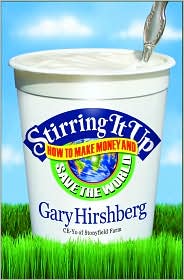
 This essay was written for my food class at Baruch, a business college. It was interesting to consider industrial organics in this light, especially since my views tend to be in favor of more participatory modes of food production--regional food systems, farmer cooperatives, CSA's, and food co-ops. Here in NYC, you can buy a container of biodynamic Hawthorne Valley yogurt from the farmer's market for just a few cents more than Stonyfield's organic yogurt. The taste of Hawthorne Valley knocks the socks off anything else, but I also buy Stonyfield when I can't get to the farmer's market because conveniently it is sold in my grocery store.
In his book, Stirring It Up, CE-Yo Gary Hirshberg extols the adoption of sustainable business practices as a financial imperative for doing business successfully in the new era of consumer consciousness. Citing evidence from his yogurt company, Stonyfield Farm, and other “green” businesses, he explains “how to make money and save the world.”
Traditionally, industrial food interests have spent millions of dollars lobbying politicians to maintain weak regulations and standards in the production of food in the United States. In contrast, Hirshberg was one of the instrumental business leaders pushing for more governmental oversight and regulation in the area of organic food. As a result of having significant input into the regulations, his company was ahead of the curve and was ready to comply with the regulations as they were adopted. Through the standardization of organics, Hirshberg pushed for more transparency, an idea that seems antithetical to the rest of the food industry that works so hard to divorce the realities of production from the experiences of consumption.
In terms of consumption, Stonyfield is more concerned with building brand loyalty than maximizing one time purchases of individual products. There is a feeling of authenticity that comes across in Stonyfield marketing that Hirshberg has carefully crafted and shielded from exploitation. Hirshberg has taken care to appeal to the sensibilities and worldview of his consumers in meaningful ways. One such example is printing political messages on the tops of the yogurt containers designed to be mailed to government officials—despite the cost of losing some purchase orders in Washington DC, as a result. Understanding that organic consumers often view food purchasing as an ethical and political act, he has positioned his company as selling a philosophy, not just a product. Industrial food is typically sold to maximize profits, and is traditionally more concerned with getting the highest number of units off the shelves as quickly as possible, with little regard for the consumer’s experience of the product after the purchase.
In their effort to sell the most product at the highest profit, the meat industry has sickened and even killed thousands of consumers. Clearly, industrial meat production has very little invested in the health and well-being of their consumers or the environment. Stonyfield is committed not only to the health of their consumers, but the health of the animals who produce the milk, the farmers who raise the animals, and the earth on which we all sit. Hirshberg has put quality ahead of profits, a business decision that has helped him capture a huge share of the yogurt market in a short amount of time. Rival yogurt company, Dannon, and fellow subsidiary of parent company, Group Danone, had to recall large quantities of its yogurt in 2007 after it was found to contain unsafe levels of dioxins, harmful man-made chemicals with high toxic and carcinogenic potential. Hirshberg has found that consumers respect and respond to companies who take issues of public health and safety seriously, not just as an apologetic afterthought.
With Hirshberg’s background as an environmental educator on a biodynamic farm, regard for closed-loop systems that minimize waste outputs are a central tenet of his business plan. He cites the example of a typical “out of the box” solution to waste that arose when a large batch of yogurt that was found to be of inferior consistency had already been packed and sealed. Instead of shipping the yogurt cups to a landfill, he fed the runny yogurt to a very grateful herd of farm animals who licked every drop clean, yielding a pile of clean cups for recycling. On the other end of the spectrum, consider the way that poultry giants Purdue and Tyson of Delmarva have refused to take responsibility for the agricultural runoff that is the single largest source of pollution in the Chesapeake Bay, and other bodies of water near their CAFOs and factory farms around the country. Hirshberg provides a blueprint for how business can be active in their own environmental waste solutions, and even profit from doing so.
Despite its name, Stonyfield Farm is not an actual farm. The company relies on suppliers and dairy farmers to provide milk and other ingredients which are processed into yogurt. In a wide departure from food-business as usual, Hirshfield insists on paying his suppliers and dairy farmers a living wage. When the company was just beginning to produce organic yogurt, he leveraged the profits from conventional yogurt sales to support the higher expense of producing quality organic yogurt. In a direct sense, Hirshfield was making an investment in his suppliers. Indirectly, he was investing in his customers and their desire for an affordable and organic yogurt. Industrial food systems try to squeeze their suppliers to get raw materials as cheaply as possible in order to maximize profits and lower prices. Whole Foods market has run into this problem, among others, in their sourcing of organic produce from China, and has been accused of using forced labor and farms that were neither certified nor traceable as organic operations.
Corporate consolidation of the organic food industry is laden with many significant problems, namely a loss of the connection between growers and consumers, and the potential for compromised standards as the chain of production elongates. Despite these valid concerns, Hirshberg’s arguments for the graceful integration of sustainable business practices should not be dismissed. This is not the sort of business model that a permaculture farmer such as Joel Salatin of Polyface Farms would likely choose to emulate. Hirshberg does however provide economically practical ideas for how industrial food can become more sustainable, which benefits shareholders, consumers and the environment.

